 Email:
  Telephone: +86-13951382065
 English
 中文简体
中文简体 русский
 Français
 Español
 عربى
عربى
Content
- 1 What Are CAPEX and OPEX in Grinding Projects?
- 2 The Real CAPEX Components: From Mill Purchase to Turnkey Line
- 3 The Hidden OPEX: Energy, Wear Parts, and Downtime
- 4 10-Year Total Cost of Ownership (TCO) Comparison
- 5 CAPEX vs. OPEX in EPCM Turnkey Projects
- 6 Upgrade Kits: A Hybrid Cost Strategy
- 7 How to Optimize Your Grinding Project Budget
Your grinding system's purchase order tells less than half of the financial story. A plant manager reviewing quarterly reports often finds that the electric bill alone has already surpassed the depreciation charge of the mill itself. That pattern repeats across hundreds of mineral processing plants — and it reveals a fundamental truth: in any size-reduction project, the visible capital price tag is only the down payment on a much larger 10-year operational stream.
To build an accurate project budget, you need to split costs into two categories: what you spend to get the line running (CAPEX) and what you spend every month to keep it running (OPEX). In grinding projects — whether you're producing 200-mesh calcium carbonate, barite, or dolomite — the interplay between these two buckets determines whether a “cheap” mill becomes a long-term financial drain.
What Are CAPEX and OPEX in Grinding Projects?
In the heavy-industry context, CAPEX (capital expenditure) includes the one-time investments that put a grinding system into operation. Purchase of the main mill, classifier, fan, dust collector, civil foundations, structural steel, electrical installation, and the first set of wear parts all fall here. These costs are capitalized on the balance sheet and depreciated over the asset's useful life, typically 10–15 years for a well-engineered mill.
OPEX (operational expenditure) covers the recurring costs you cannot escape. Every kilowatt-hour consumed by the main motor, every spare roller and ring set replaced, every hour of labor spent on maintenance, and every ton of product lost during unplanned downtime — all of it flows through the monthly income statement. In grinding, OPEX dwarfs CAPEX over time. A 10-tph plant may spend four to six times its initial equipment cost on power and consumables within a decade.
A simple way to see the split:
- CAPEX: Mill frame, classifier, dust system, foundation, installation, commissioning, initial spares.
- OPEX: Electricity, wear parts (rollers, rings, liners, filter bags), maintenance labor, lubrication, unplanned downtime.
The Real CAPEX Components: From Mill Purchase to Turnkey Line
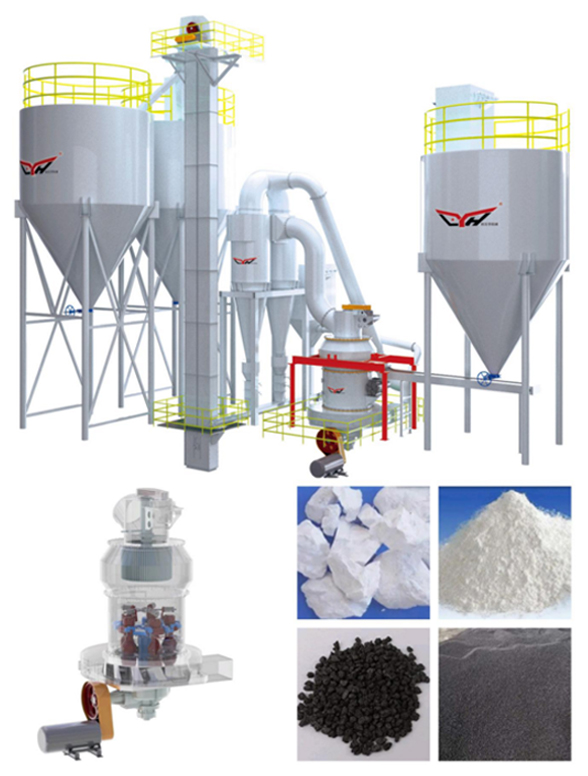
Many first-time buyers fixate on the mill’s price tag alone. In reality, a complete grinding line draws capital from multiple streams. When you buy a single machine, you still need to cover installation, basic controls, and a few spare parts. A turnkey EPCM scope folds in civil works, conveying systems, dedusting, and design engineering, which can double or triple the budget.
The table below compares typical CAPEX distribution for a 10-tph pendulum mill line under two procurement strategies.
| Cost Item | Single Machine Purchase (% of CAPEX) | Turnkey EPCM Line (% of CAPEX) |
|---|---|---|
| Main mill & internal classifier | 78% | 52% |
| Fan, piping, dust collector | 12% | 15% |
| Civil foundation & steel structure | — | 12% |
| Installation & commissioning | 7% | 14% |
| Initial set of wear parts | 3% | 4% |
| Design, engineering, project management | — | 3% |
Selecting a modern LYH998 pendulum mill with factory-integrated controls can lower installation time and reduce the gap between machine cost and total CAPEX. The more pre-assembled and pre-tested the package, the fewer on-site surprises and cost overruns.
The Hidden OPEX: Energy, Wear Parts, and Downtime
Electricity: 40–60% of Operating Costs
No line item competes with the power bill. For a calcium carbonate plant grinding to 200 mesh (D97 45 µm), specific energy consumption typically ranges from 22 to 35 kWh per ton, depending on mill type and classifier efficiency. At an industrial rate of $0.08/kWh, a 10-tph line running 7,000 hours a year burns through $170,000 to $280,000 just for the main motor. Over 10 years, that single OPEX component can exceed $2 million — enough to buy the entire production line several times over.
Every 1 kWh/ton saved translates into roughly $8,000 per year for a 10-tph operation. This is why mill selection — not the initial price — drives lifecycle economics.
Wear Parts: The Cost You Pay Every 12–18 Months
Grinding is an attrition business. Rollers, rings, liners, and classifier blades grind themselves down while reducing your product. A standard pendulum mill’s roller ring set may need replacement every 12–18 months, costing $15,000–$25,000 per set. Over a decade, a plant with aggressive wear rates can incur $150,000–$200,000 in consumables alone.
Material choice matters enormously. High-chromium alloy rollers carry a 50% price premium but can double service life, cutting the annualized replacement cost by 25–30%. Understanding your material's abrasiveness and the proper wear part replacement cycle lets you forecast OPEX with precision rather than reacting to emergency shutdowns.
Unplanned Downtime: The Invisible Drain
Every hour a mill stops, production worth $500–$1,000 vanishes. An unscheduled bearing replacement or classifier blockage that takes two shifts erases not just the repair labor but also the value of 100–200 tons of unsold powder. Even if a plant operates at 85% availability, the 15% downtime can represent hundreds of thousands of dollars annually in lost opportunity — a cost that never appears on a spare-parts invoice.
10-Year Total Cost of Ownership (TCO) Comparison
To make CAPEX-vs-OPEX trade-offs tangible, consider a hypothetical 100,000-tons-per-year calcium carbonate plant targeting D97 = 45 µm. The table below contrasts three grinding system scenarios: a basic Raymond-style mill, an intelligent 4-roller pendulum mill, and a modern vertical ring-roller mill. All figures are illustrative and built on a $0.08/kWh power rate and U.S. Gulf Coast labor assumptions.
| Scenario | Initial CAPEX ($) | Annual Energy ($) | Annual Wear Parts ($) | Annual Labor ($) | 10-Yr Total OPEX ($) | 10-Yr Total Cost ($) | Payback vs. Std Raymond (years) |
|---|---|---|---|---|---|---|---|
| Standard Raymond Mill (no optimizer) | 200,000 | 280,000 | 45,000 | 80,000 | 4,050,000 | 4,250,000 | — |
| 4-Roller Pendulum Mill with PLC (like LYH998) | 380,000 | 224,000 | 32,000 | 65,000 | 3,210,000 | 3,590,000 | 2.1 |
| Vertical Ring-Roller Mill (like LYH996) | 650,000 | 176,000 | 28,000 | 55,000 | 2,590,000 | 3,240,000 | 3.1 |
The higher-priced vertical ring-roller mill recovers its additional upfront cost in just over three years solely through energy and labor savings. After 10 years, it delivers a cumulative cost advantage of more than $1 million compared with the standard Raymond mill. That gap widens further if electricity prices rise, because the most efficient mill protects your OPEX from tariff volatility.
CAPEX vs. OPEX in EPCM Turnkey Projects
A full turnkey contract blurs the CAPEX-OPEX boundary unless you deliberately structure the scope. When you sign an EPCM deal, the supplier handles engineering, procurement of all equipment, civil construction, installation, commissioning, and even operator training. Accounting rules treat some of these activities as capitalizable (they become part of the asset’s depreciable base) and others as current expenses.
A clear separation avoids tax headaches later:
- Capitalize: equipment cost, freight of long-lead items, civil engineering and concrete works, mechanical and electrical installation directly needed to bring the asset into service, commissioning activities essential for validation.
- Expense as OPEX: operator and maintenance training, consumable raw materials used during trial runs, debug labor not tied to permanent asset construction, first-fill lubricants and filter bags consumed in testing.
Working with a supplier who structures the contract to maximize the capital portion — while keeping compliance with local accounting standards — improves your balance sheet and preserves operating cash. A turnkey EPCM approach should include a detailed cost breakdown aligned with your finance team’s capitalization policy from day one.
Upgrade Kits: A Hybrid Cost Strategy
Replacing an entire grinding line isn’t always feasible. Upgrade kits — retrofitting a variable-frequency drive, intelligent load-sensing controller, high-efficiency motor, or new classifier — sit in a gray area between maintenance OPEX and capital improvement. If the upgrade extends asset life, improves throughput, or reduces energy consumption, accounting standards often treat it as CapEx, depreciable over the remaining life of the asset.
The financial logic is compelling. The table below illustrates the economics of a typical control-system upgrade on an existing pendulum mill.
| Parameter | Upgrade Kit (PLC + VFD + IE4 motor) | New 4-roller Mill Line |
|---|---|---|
| Initial CapEx | $48,000 | $380,000 |
| Electricity saving | 12% | 20–22% |
| Wear part cost reduction | 15% (through stable load) | 25% (optimized geometry + materials) |
| Typical payback period | 1.8 years | 2.1 years (vs. old mill) |
For plants with solid infrastructure but outdated controls, a targeted upgrade kit can slash OpEx with a fraction of the CapEx required for a greenfield line. It also defers the need for a full capital appropriation while immediately improving cash generation.
How to Optimize Your Grinding Project Budget
Shifting the cost ratio in your favor requires deliberate choices long before the first truckload of material arrives. The most successful plant owners treat CAPEX and OPEX as a single 10‑year envelope, not as isolated line items.
- Specify high-efficiency motors (IE4 or IE5) — the 2–4% efficiency gain over an IE3 motor reduces annual electricity cost by $5,000–$10,000 per motor in a mid-size plant, often paying back the premium within 18 months.
- Lock in a long-term wear-parts agreement. Volume commitments over 3–5 years can lower per-set pricing by 10–18% and guarantee availability, turning a volatile OpEx line into a predictable cost.
- Invest in full negative-pressure dust control. By preventing abrasive dust from contacting bearings and seals, a well-designed negative-pressure system can double filter bag life and cut maintenance OpEx markedly.
- Choose a mill with native intelligent control. Real-time feed-rate optimization and automatic roll-gap adjustment reduce specific energy per ton by 5–8%, a direct OpEx reduction that compounds over the asset’s life.
- Structure EPCM contracts with tax treatment in mind. Request a line-by-line cost split before signing, and work with your finance team to classify every dollar correctly — a few hours of upfront analysis can shift hundreds of thousands of dollars into depreciable CapEx rather than immediate OpEx.
None of these moves demand rewriting your business model. They are small shifts in procurement behavior that, when stacked together, transform a grinding line from a cash-hungry operation into a predictable, low-OpEx asset.
 Email:
  Telephone: +86-13951382065
 Phone: +86-13951382065