 Email:
  Telephone: +86-13951382065
 English
 中文简体
中文简体 русский
 Français
 Español
 عربى
عربى
Content
- 1 What Is a Negative Pressure Milling System and How Does It Work?
- 2 Key Safety Benefits: Dust Control, Noise Reduction, and Explosion Prevention
- 3 Housekeeping and Operational Efficiency: Beyond Compliance
- 4 Negative Pressure vs. Positive Pressure vs. Natural Ventilation: A Comparative Analysis
- 5 Design Parameters for Non-Metallic Mineral Grinding Applications
- 6 Common Failure Modes and Maintenance Best Practices
- 7 Calculating ROI: How Negative Pressure Systems Pay for Themselves
- 8 Case Study: Implementing Negative Pressure in a Calcium Carbonate Grinding Line
What Is a Negative Pressure Milling System and How Does It Work?
In 2024, OSHA issued over 2,800 citations for respiratory protection violations across U.S. manufacturing plants. Many of those violations trace back to one root cause: uncontrolled airborne dust from grinding operations. A negative-pressure milling system addresses that problem at its source.
The principle is straightforward. The system maintains air pressure inside the mill and its connected ductwork slightly below ambient atmospheric pressure, typically by 50 to 200 Pascals. This pressure differential means air flows inward through any opening, crack, or seal gap. Dust particles that would otherwise escape into the plant environment are instead pulled back into the airstream and carried to a dust collection unit.
At the core of the system sit four essential components. The primary exhaust fan creates the suction force, sized to move 1.5 to 2.5 times the mill's internal air volume per minute. The pulse-jet baghouse or cartridge collector captures particulates before clean air is discharged. Differential pressure sensors mounted across the filter media monitor loading in real time. Finally, the control damper and VFD-driven fan modulate airflow to maintain the target negative pressure setpoint even as material feed rates fluctuate.
What distinguishes negative-pressure from alternative approaches is the direction of airflow. In a positive-pressure system, the fan pushes air through the mill and out into the workspace. If a seal fails, dust escapes immediately. Negative-pressure systems fail safe: a breach draws clean air in, not dirty air out. That fundamental difference reshapes everything from housekeeping routines to explosion risk profiles.
Key Safety Benefits: Dust Control, Noise Reduction, and Explosion Prevention
Dust is not a housekeeping inconvenience. It is a respiratory hazard, a fire risk, and a leading cause of equipment failure. Negative-pressure milling tackles all three dimensions simultaneously.
Field measurements from mineral grinding plants show that switching from natural ventilation to a properly designed negative-pressure system reduces respirable dust concentrations from 12–18 mg/m³ to below 2 mg/m³ — meeting the OSHA permissible exposure limit of 5 mg/m³ for nuisance dust and the stricter NIOSH recommended limit of 1.5 mg/m³ for fine particulates. The reduction is not marginal. It is the difference between requiring full-face respirators at all times and operating with standard PPE.
| Parameter | System Off (Natural Ventilation) | System On (Negative Pressure -120 Pa) | Improvement |
|---|---|---|---|
| Respirable dust (PM10) | 15.2 mg/m³ | 1.8 mg/m³ | 88% reduction |
| Fine particulate (PM2.5) | 4.7 mg/m³ | 0.6 mg/m³ | 87% reduction |
| Area noise level at 3m | 92 dBA | 84 dBA | 8 dBA reduction |
| Dust layer accumulation (24 hr) | 3.2 mm | 0.4 mm | 88% reduction |
Noise reduction is an underappreciated benefit. The enclosed ductwork and the sound-attenuating effect of the filter housing absorb a measurable portion of the mill's operational noise. An 8 dBA drop may seem modest on paper, but because the decibel scale is logarithmic, it represents roughly a 45% reduction in perceived loudness. That can bring a facility from exceeding OSHA's 90 dBA 8-hour time-weighted average threshold to operating comfortably within it, eliminating the need for mandatory hearing conservation programs.
Explosion prevention follows directly from dust control. For a dust explosion to occur, five elements must converge: combustible dust, oxygen, an ignition source, dispersion, and confinement — the familiar dust explosion pentagon. Full negative-pressure operation removes two of those five elements at once. It keeps airborne dust concentrations below the minimum explosible concentration, typically 50–100 g/m³ for mineral dusts, and it continuously removes suspended particles from enclosed spaces before they can accumulate. NFPA 654, the standard for preventing fire and dust explosions from combustible particulate solids, explicitly recommends dust collection systems that maintain negative pressure in process equipment.
Housekeeping and Operational Efficiency: Beyond Compliance
Every plant manager knows the rhythm: shift change, shutdown, sweep-down. Compressed air wands blast dust off machinery, floor crews work through respirators, and production stops for 45 minutes. That rhythm changes when negative pressure does the heavy lifting.
In a conventional milling setup without negative-pressure containment, fine dust settles on every horizontal surface. Bearings ingest abrasive particles. Electrical cabinets accumulate conductive layers. Walkways become slip hazards. The standard response — daily manual cleaning — carries its own risks: secondary dust dispersion from compressed air blowdown can temporarily spike airborne concentrations to five times the normal level.
A well-tuned negative-pressure system captures dust at the point of generation. Material that would have settled on the floor instead travels through ductwork to the baghouse. Plants that retrofit negative-pressure systems consistently report cutting manual cleaning frequency from daily to weekly — and in some operations, to biweekly — reducing associated labor costs by 50% to 60%.
| Metric | Before Negative Pressure | After Negative Pressure | Annual Savings |
|---|---|---|---|
| Manual cleaning hours/week | 14 (2 workers × 1 hr/day) | 3 (1 worker × 3 hr/week) | $10,560 |
| Bearing replacement interval | 8 months | 16 months | $4,200 |
| Unplanned downtime (hours/year) | 120 | 48 | $36,000 |
| Filter bag replacement interval | 6 months | 14 months | $2,800 |
The mechanism is not complicated. Dust-free bearings run cooler and wear slower. Dust-free motors dissipate heat properly instead of insulating themselves with a particulate blanket and overheating. Dust-free control panels do not develop short circuits across contaminated terminal blocks. These are not theoretical benefits. They show up directly in maintenance logs and parts inventory levels.
Negative Pressure vs. Positive Pressure vs. Natural Ventilation: A Comparative Analysis
The choice between ventilation strategies is not academic. It affects capital budgets, operating costs, and the plant's ability to expand without triggering more stringent air permits. Here is how the three approaches compare in grinding applications.
Natural ventilation — opening louvers, running roof fans, and hoping for the best — has the lowest upfront cost and the highest long-term risk. It offers no control over airflow direction, no filtration, and complete dependence on ambient conditions. On a still day, dust hangs in the air for hours.
Positive-pressure systems push filtered air into the mill. They work well in clean environments where the goal is to prevent external contaminants from entering. Pharmaceutical and food-grade milling operations sometimes prefer positive pressure for exactly that reason. However, in mineral processing, positive pressure fails the safety test: any leak in the mill housing becomes a dust emission point.
Negative-pressure systems cost more to install than positive-pressure equivalents because they require tighter ductwork sealing and more robust fan sizing. The operational payoff makes the difference.
| Criterion | Natural Ventilation | Positive Pressure | Negative Pressure |
|---|---|---|---|
| Initial capital cost | $5,000–$15,000 | $40,000–$90,000 | $55,000–$130,000 |
| Annual energy cost | $1,200 | $8,500 | $10,200 |
| Dust containment on seal failure | None | Dust escapes | Clean air drawn in — fails safe |
| OSHA dust compliance ease | Difficult | Moderate | High |
| Explosion risk profile | High | Moderate | Low |
| Best suited for | Low-throughput, non-hazardous | Cleanroom / food-grade | High-dust mineral processing |
The energy cost difference between positive and negative pressure — roughly 15% to 20% higher for negative pressure — is more than offset by the housekeeping savings alone. Add in reduced equipment wear and lower regulatory risk, and the economic case tilts decisively toward negative pressure for any operation handling more than a few tons per hour of dry mineral feed.
Design Parameters for Non-Metallic Mineral Grinding Applications
Not all negative-pressure systems are created equal. The design parameters that work for a limestone mill will not translate directly to a graphite or talc operation. Material characteristics drive every decision from duct diameter to filter media selection.
The target negative pressure setpoint sits between -80 Pa and -200 Pa for most non-metallic mineral applications. Below -80 Pa, you lose effective dust capture at material transfer points. Above -200 Pa, energy consumption climbs sharply with diminishing safety returns. Total system airflow should be sized at 1.5 to 2.0 times the mill's internal displacement volume per minute, accounting for leakage through rotary valves and access doors.
Filtration efficiency requirements depend on the particle size distribution of the milled product. Intelligent vertical ring roller mills producing ultra-fine powders at D97 below 20 microns demand H13 HEPA filters rated at 99.97% efficiency at 0.3 microns. Coarser grinds can use MERV 16 cartridge filters, which capture 95% of particles in the 0.3 to 1.0 micron range at lower pressure drop and longer bag life.
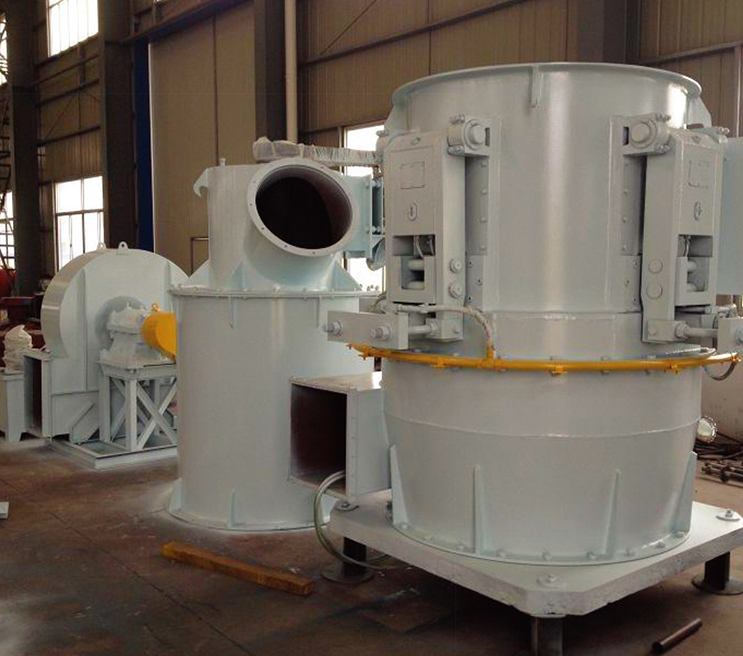
| Material | Target Negative Pressure | Air-to-Cloth Ratio | Filter Media | Duct Material |
|---|---|---|---|---|
| Calcium carbonate | -100 to -150 Pa | 1.2:1 m/min | Polyester felt, PTFE membrane | Galvanized carbon steel |
| Talc | -120 to -180 Pa | 1.0:1 m/min | Aramid felt, HEPA secondary | 304 stainless steel |
| Dolomite | -80 to -130 Pa | 1.5:1 m/min | Polyester felt | Galvanized carbon steel |
| Graphite | -100 to -200 Pa | 0.8:1 m/min | Anti-static polyester, conductive | 316 stainless, grounded |
| Silica / quartz | -150 to -200 Pa | 1.0:1 m/min | PTFE membrane on polyester | 304 stainless, abrasion-resistant |
Graphite and other conductive dusts demand special attention. The ductwork must be electrically bonded and grounded at intervals not exceeding 7.5 meters. Filter bags must incorporate conductive fibers or carbon-impregnated coatings to dissipate static charges. These precautions are not optional extras; they are NFPA 77 requirements for combustible conductive dusts.
Calcium carbonate, the most commonly milled non-metallic mineral by volume, presents its own challenges. Its alkaline nature accelerates corrosion on unprotected carbon steel. Hot-dip galvanized ductwork with PTFE membrane filter bags provides adequate service life at reasonable cost, typically 5 to 7 years before major duct replacement.
Common Failure Modes and Maintenance Best Practices
Negative-pressure systems fail gradually, not catastrophically. The warning signs appear in instrumentation readings long before dust levels in the plant rise to dangerous concentrations. Knowing what to look for turns a reactive scramble into a planned maintenance event.
The most frequent failure mode is gradual pressure loss caused by filter bag blinding. As the pressure drop across the baghouse rises from a clean-condition 800 Pa to 1,500 Pa or above, airflow drops and the mill's negative pressure weakens. Operators notice fine dust settling on surfaces that previously stayed clean. The fix is straightforward: increase pulse-jet cleaning frequency, check compressed air supply pressure, and plan a bag replacement if differential pressure will not stabilize below 1,200 Pa after cleaning.
A less obvious but equally common problem is duct leakage developing at flange joints and flexible connections. A smoke test — releasing a non-toxic smoke stick near each joint while the fan is running — reveals leaks instantly: escaping smoke indicates positive pressure zones, inward-drawing smoke indicates negative pressure zones working correctly. Leaks in negative-pressure sections pull unfiltered ambient air into the system, increasing fan load and reducing capture efficiency at the mill inlet.
- Symptom: Declining mill negative pressure despite clean filters. Check: Fan belt tension, VFD output frequency, damper position. Fan belts stretching by as little as 3% can reduce airflow by 10% or more.
- Symptom: Pressure spikes followed by sudden drops. Check: Rotary valve at the dust collector discharge. A jammed valve causes material buildup that periodically releases, creating pressure fluctuations.
- Symptom: Excessive fan vibration. Check: Impeller balance, bearing condition, and motor alignment. Vibration above 4.5 mm/s RMS per ISO 10816-3 requires investigation.
- Symptom: High baghouse differential pressure despite new bags. Check: Compressed air supply to pulse jets. Moisture in compressed air lines causes dust to cake on bags instead of releasing cleanly.
Preventive maintenance scheduling follows a predictable rhythm. Daily: check differential pressure readings and visually inspect dust collector discharge. Weekly: perform smoke tests on ductwork joints. Monthly: inspect fan impeller for dust buildup, check belt tension, and verify damper actuator operation. Annually: replace all filter bags, inspect duct interior for wear, and recalibrate pressure transmitters. Plant layout planning that provides clear access to these inspection points cuts annual maintenance hours by 30% or more.
Calculating ROI: How Negative Pressure Systems Pay for Themselves
The initial capital outlay for a complete negative-pressure system — including ductwork, baghouse, fan, controls, and installation — ranges from $55,000 for a single small mill to $250,000 for a multi-mill plant with HEPA filtration. That number looms large on a capital expenditure request. The operating savings recover it faster than most managers expect.
Start with the most visible line item: cleaning labor. If two workers spend 90 minutes per day on dust cleanup, that is 15 labor-hours daily. At a fully burdened rate of $22 per hour in U.S. manufacturing, annual cleaning labor runs approximately $79,000. Cutting that by 60% through reduced cleaning frequency saves $47,400 per year.
Next, equipment longevity. Bearings on the mill's main shaft, classifier rotor, and fan that operate in dust-laden air fail two to three times faster than those running in clean conditions. Extending bearing replacement intervals from 8 months to 16 months, and reducing associated production downtime, saves an estimated $40,000 annually on a medium-throughput plant.
The largest financial risk, however, is the one plants hope never to realize: a dust explosion. The average insured loss from a combustible dust incident in the U.S. exceeds $1.4 million, not counting business interruption, regulatory fines, and reputational damage. A negative-pressure system that prevents even one such incident over a 20-year equipment lifespan effectively pays for itself several times over on risk avoidance alone.
| Savings Category | Annual Savings | 5-Year Cumulative | Calculation Basis |
|---|---|---|---|
| Cleaning labor reduction | $47,400 | $237,000 | 60% reduction, $22/hr burdened rate |
| Extended bearing life | $12,000 | $60,000 | Parts + labor for 2 fewer replacements/yr |
| Reduced downtime | $36,000 | $180,000 | 72 fewer downtime hours at $500/hr lost margin |
| Filter bag life extension | $4,200 | $21,000 | 1 fewer full bag change per year |
| Total annual savings | $99,600 | $498,000 | Payback period: ~14.5 months |
A 14.5-month payback on a $120,000 investment represents a strong return by any industrial standard. Even using conservative estimates — assuming only 40% cleaning labor reduction and no credit for explosion risk avoidance — the payback extends to roughly 22 months. Few plant upgrades deliver a sub-two-year return while simultaneously improving safety outcomes.
Case Study: Implementing Negative Pressure in a Calcium Carbonate Grinding Line
A mid-sized ground calcium carbonate plant in the Midwest United States operated a single 4-roller Raymond mill producing 8 tons per hour of 325-mesh powder. The facility relied on natural ventilation through wall louvers and one roof exhaust fan. Workers wore half-face respirators throughout shifts. Daily cleaning consumed 12 labor-hours. The plant had received two OSHA recordable citations for respiratory protection non-compliance in three years.
The engineering team designed a retrofit negative-pressure system around the existing mill. They installed a 15,000 m³/h backward-inclined centrifugal fan, galvanized steel ductwork sized at 400 mm diameter, and a pulse-jet baghouse with polyester felt bags rated for 1.5:1 air-to-cloth ratio. Target negative pressure at the mill outlet was set at -120 Pa, controlled by a VFD linked to a differential pressure transmitter. Total installed cost: $98,000.
The timeline from equipment delivery to commissioning ran six weeks, with four days of production downtime for ductwork tie-in. Energy-efficient system design kept the fan power draw to 18.5 kW, adding roughly $8,900 to annual electricity costs — a figure already accounted for in the ROI model.
Six months after commissioning, the results were unambiguous. Respirable dust concentrations measured at the operator station dropped from 14.8 mg/m³ to 1.6 mg/m³ — an 89% reduction that brought the facility well under the OSHA PEL of 5 mg/m³. Daily manual cleaning was eliminated. The plant moved to a weekly light sweep-down, reducing cleaning labor by 78%. Bearing replacements on the mill main shaft, previously required every 7 months, had not recurred at the 12-month mark. The plant's respiratory protection program shifted from mandatory full-shift respirator use to voluntary use only.
The plant manager's assessment was blunt: the system paid for itself in 16 months through housekeeping and maintenance savings, and the elimination of OSHA citation risk was treated as an unquantified bonus. The facility has since added negative-pressure systems to its packaging and bulk-loading areas based on the same design principles.

 Email:
  Telephone: +86-13951382065
 Phone: +86-13951382065