 Email:
  Telephone: +86-13951382065
 English
 中文简体
中文简体 русский
 Français
 Español
 عربى
عربى
Content
- 1 Why Feed Size Matters in Dolomite Grinding Line Design
- 2 Step 1 – Crushing Stage: From Run-of-Mine to Mill Feed
- 3 Step 2 – Mill Selection: Matching Feed Size with Target Fineness
- 4 Step 3 – Classifier & Dust Collector: Fine-Tuning Product Quality
- 5 Energy & Wear Cost Comparison Across Mill Types
- 6 Real-World Case: From 200 mm Feed to 800 Mesh Dolomite Powder
- 7 Common Design Mistakes and How to Avoid Them
- 8 Conclusion: Building a Cost-Effective Dolomite Grinding Line
Why Feed Size Matters in Dolomite Grinding Line Design
Every dolomite grinding line starts with a simple number: the size of the rock entering the system. That single value dictates how many crushing stages you need, which mill type will work efficiently, and how much energy your operation will consume per ton of finished powder. Skip this step, and you will pay for it in excessive wear, low capacity, or constant blockages at the mill inlet.
Engineers often inherit run-of-mine material ranging from 500 mm boulders down to 30 mm clean stone. Reducing that to a mill-ready feed of 10–30 mm is not a one-size-fits-all job. A system designed for 50 mm input will stall if fed 400 mm rocks. Conversely, over-crushing wastes power and generates unnecessary fines. The right approach matches crushing intensity to the input size so that every kilowatt-hour moves you closer to the target fineness.
Three cost levers make feed size the linchpin of whole-line economics. First, crushing stages: each extra stage adds capital expenditure (CapEx) and maintenance. Second, mill throughput: a mill fed with properly sized material runs at rated capacity; oversized feed can drop throughput by 30% or more. Third, liner and grinding media wear: larger particles increase impact stress, shortening component life. Designing backward from the feed opening of your chosen mill is the only reliable path to a line that meets both output and budget targets.
Step 1 – Crushing Stage: From Run-of-Mine to Mill Feed
The gap between a freshly blasted dolomite block and the 10–30 mm particles a grinding mill expects must be closed by one, two, or three crushing stages. No rule of universal best practice exists; the number of stages depends entirely on the as-mined size and the required reduction ratio.
| Run-of-Mine Size | Crushing Stages | Typical Equipment Sequence | Expected Mill Feed |
|---|---|---|---|
| Less than 50 mm | 1 stage (or bypass) | Hammer crusher / fine cone | 10–20 mm |
| 50–200 mm | 2 stages | Jaw crusher → impact crusher | 15–25 mm |
| 200–500 mm | 2 or 3 stages | Jaw → cone/impact → fine crusher | 15–30 mm |
| Over 500 mm | 3 stages | Heavy jaw → cone → sand-maker or tertiary cone | 15–30 mm |
For mid-size feeds (50–200 mm), a two-stage setup with a jaw crusher and an impact crusher provides a good balance. The jaw handles the coarsest lumps, while the impact crusher shapes the particles and delivers the required upper size limit. When feed size exceeds 200 mm—common in mines with limited primary screening—adding a tertiary stage prevents oversized material from reaching the mill. A fine cone crusher or a vertical shaft impactor works well here, especially when the goal is a narrow size distribution with minimal <5 mm fines that would bypass the mill’s grinding zone inefficiently.
Dolomite’s medium hardness (Mohs 3.5–4) works in favor of impact-based secondary crushing. Compared to only using cone crushers, an impact crusher yields a more cubical product and helps avoid slabby fragments that cause bridging in mill feed hoppers. The trade-off is higher blow bar wear, so monitoring the metal content of the incoming material becomes essential. Installing a magnetic separator before the secondary crusher protects the impactor and pays for itself in reduced downtime.
Step 2 – Mill Selection: Matching Feed Size with Target Fineness
Once the crushing system delivers a consistent mill feed, the real design decision begins: which grinding technology matches both the input particle size and the desired final product? Too often, selections are made on average capacity alone, ignoring the feed size constraints that determine whether a mill can even accept the crushed material without a pre-grinding stage.
A decision matrix clarifies the options. It maps typical feed size ceilings for Raymond mills, vertical ring roller mills, ball mills, and ultrafine classifiers against the most common dolomite product fineness targets.
| Target Fineness | Feed ≤10 mm | Feed ≤30 mm | Feed ≤50 mm |
|---|---|---|---|
| 200 mesh (74 µm) | Raymond mill / ball mill | Ball mill / vertical mill | Vertical mill |
| 325 mesh (44 µm) | Raymond mill (4R/5R) | Raymond mill / vertical ring roller mill | Vertical ring roller mill |
| 800 mesh (18 µm) | Ultrafine Raymond / vertical ring roller mill | Vertical ring roller mill | Vertical ring roller mill (with pre-crushing) |
| 1250 mesh (10 µm) | Ultrafine vertical mill / classifier mill | Ultrafine vertical mill | Not recommended without pre-grinding |
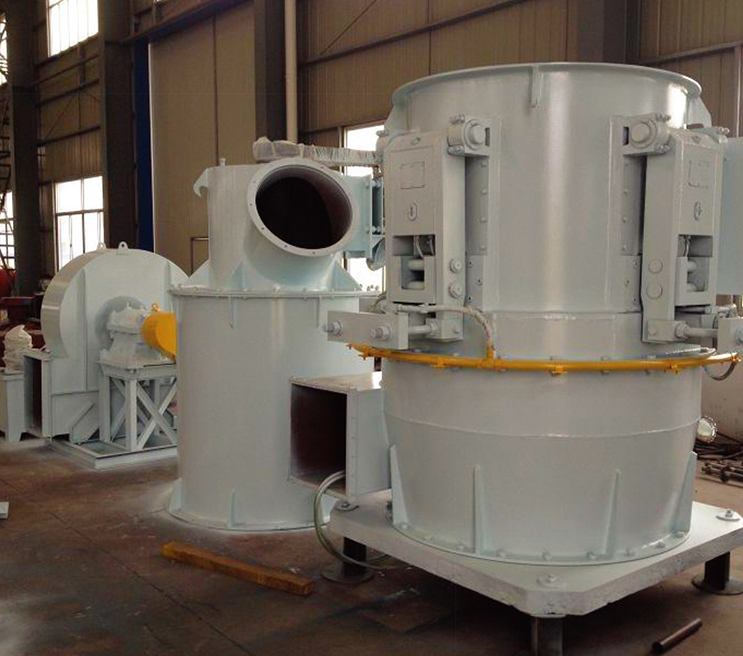
For medium-fine outputs between 325 and 800 mesh with a feed around 30 mm, the Raymond-type pendulum mill remains a workhorse. Our LYH998 4-roller grinding pendulum mill accepts feed up to 30 mm and delivers product fineness from 325 to 1250 mesh, producing 1–20 t/h depending on the configuration. When the feed approaches 50 mm and the target is 800 mesh or finer, a vertical ring roller mill becomes the more energy-efficient path. The LYH996 intelligent vertical ring roller mill handles coarser feed under full negative pressure, reducing power draw per ton while maintaining precise particle size control.
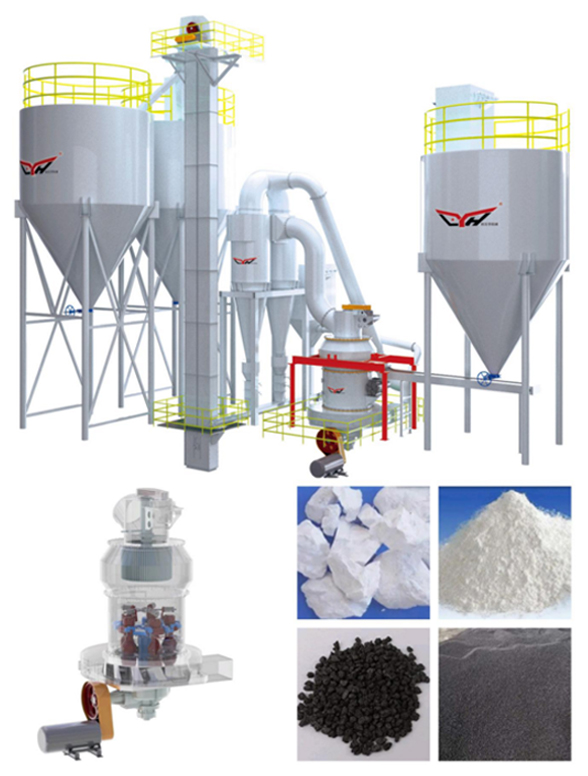
The decision matrix also reveals where ball mills fit. They still make sense for very coarse 200-mesh products at capacities above 15 t/h, but their higher specific energy consumption—typically 30–45 kWh/t versus 18–28 kWh/t for vertical mills—often makes them less attractive for all but the largest-tonnage operations. For dolomite filler grades requiring top-cut control below 10 µm, dedicated ultrafine classifier mills with secondary air classification are the final step.
Step 3 – Classifier & Dust Collector: Fine-Tuning Product Quality
A grinding mill alone cannot lock in product quality. The classifier and the dust collection circuit work together to set the exact particle size distribution and keep the plant compliant with emission limits. Ignore them, and even the best mill will deliver inconsistent powder or trigger environmental shutdowns.
Classifier speed is the primary knob for top-size control. In a typical turbo classifier attached to a Raymond mill, increasing rotor speed from 200 to 600 rpm can shift the D97 cut point from 45 µm down to 10 µm. This relationship is not linear—it depends on air volume and material density—so commissioning trials are essential. Adjusting the system’s airflow changes the cut sharpness: higher volume drags more coarse particles into the product, while lower volume improves classification accuracy at the cost of throughput. Operators learn to balance these two variables based on sieve analysis feedback every few hours.
Dust collection must be sized to match both the mill’s air volume and the fineness of the product. A 5 t/h dolomite grinding line producing 325-mesh powder typically requires a baghouse with 400–600 m² of filter area and a draft fan delivering 25,000–35,000 m³/h. As product fineness increases to 800 mesh, fugitive dust becomes finer and more challenging to capture, so filter media selection moves toward PTFE-laminated bags. Full negative-pressure designs, in which the entire grinding circuit operates under suction, keep workplace dust below 10 mg/Nm³ without needing additional hoods. This approach also stabilizes mill operation because the system’s pressure balance remains independent of ambient wind or minor leaks.
Energy & Wear Cost Comparison Across Mill Types
Capex numbers grab attention during procurement, but operating expense (OpEx) determines profitability year after year. Comparing the three most common dolomite grinding technologies—pendulum mill, vertical ring roller mill, and ball mill—reveals why the cheapest purchase price can be the most expensive long-term choice.
| Mill Type | Specific Energy (kWh/t) | Grinding Media/Roller Life (tons/part) | Annual Wear Parts Cost (est.) |
|---|---|---|---|
| Raymond pendulum mill | 25–35 | 8,000–12,000 | $0.35–0.55/ton |
| Vertical ring roller mill | 18–25 | 10,000–15,000 | $0.25–0.40/ton |
| Ball mill (closed circuit) | 30–45 | 7,000–10,000 (ball charge) | $0.50–0.80/ton |
The vertical ring roller mill’s energy advantage comes from its integrated classifier and the absence of heavy ball charges that require tumbling. At 10 tons per hour operating 6,000 hours per year, the power cost difference alone between a 20 kWh/t vertical mill and a 35 kWh/t ball mill can exceed $90,000 annually, assuming $0.10/kWh industrial power. Wear part life extends further because roller and ring surfaces experience more uniform compression than the impact-and-abrasion pattern inside a ball mill. The maintenance frequency drops accordingly: roller changes every 10,000–15,000 tons versus ball reloads every 7,000–10,000 tons. For operations targeting 800-mesh dolomite filler, where grinding intensity escalates, these gaps widen even more.
Real-World Case: From 200 mm Feed to 800 Mesh Dolomite Powder
Theoretical numbers matter, but nothing builds confidence like an actual production line. A dolomite processor in Fujian, China, needed to turn quarried rock averaging 200 mm into 800-mesh (D97=16 µm) filler for high-end coatings. The two-step crushing and grinding design they chose mirrors the decision logic explained earlier.
A jaw crusher first reduced the 200 mm stone to below 50 mm, followed by a fine impact crusher that targeted a steady 15–20 mm mill feed. The grinding core was a 5R Raymond pendulum mill coupled to a turbo classifier. The line consistently delivers 8 tons per hour at 800 mesh, with total specific energy consumption measured at 32 kWh/t—well within the expected range for this fineness. Dust emission is maintained below 5 mg/Nm³ through a 550 m² baghouse and full negative-pressure loop. The project reached nameplate capacity within 10 days of commissioning, a timeline achieved because the crushing stages were sized conservatively, leaving no bottleneck at the mill inlet. For a closer look at how such a system travels from the factory to the production site, see the LYH998175 journey from Nantong to Sanming.
Common Design Mistakes and How to Avoid Them
Even experienced teams fall into predictable traps when laying out a new dolomite grinding line. Recognizing these patterns early keeps budget and schedule intact.
- Undersized primary crushing. Selecting a jaw crusher based solely on average feed size while ignoring the maximum block dimension. Result: frequent bridging at the feed hopper and lost production hours. Solution: size the crusher opening to 1.2 times the largest expected rock.
- Insufficient air flow in the dust system. Specifying a fan based on theoretical mill air volume without accounting for elevation, temperature, or baghouse pressure drop. Consequence: negative pressure collapses, dust escapes from mill seals, and product fineness drifts. Fix: add a 15–20% safety factor to the calculated air volume and select a fan with a steep pressure curve.
- No metal separation before secondary crushing. Dolomite deposits often contain stray steel from blasting caps or bucket teeth. Running this through an impact crusher destroys blow bars within days. Install a permanent magnet or electromagnetic separator on the conveyor immediately before the secondary crusher.
- Rigid classifier speed settings. Locking the classifier at a fixed rpm without a feedback loop from online particle sizing leads to gradual shifts in D97 as mill wear changes internal circulation. Integrate a laser diffraction analyzer or at minimum a scheduled hourly sieve check and link the result to adjustable classifier speed via the PLC.
Conclusion: Building a Cost-Effective Dolomite Grinding Line
Designing a dolomite grinding line is an exercise in linking three numbers: the size of the stone that arrives, the size of the powder that leaves, and the tons per hour required. From those, every major decision follows—number of crushing stages, mill type, classifier speed, and baghouse area. There is no universal “best” mill, only the right match for your specific input and output targets.
An iterative approach works best: define target fineness first, then work backward to the mill that can produce it with the lowest whole-life cost, and finally design the upstream crushing to reliably feed that mill at the required size. When the three stages align, the result is a line that starts up quickly, runs with minimal operator intervention, and delivers consistent powder year after year. Reach out to a grinding system partner who can model your feed data and layout options before you pour the first foundation.
 Email:
  Telephone: +86-13951382065
 Phone: +86-13951382065