 Email:
  Telephone: +86-13951382065
 English
 中文简体
中文简体 русский
 Français
 Español
 عربى
عربى
Content
- 1 Why PSD Matters for Barite in Drilling and Industrial Uses
- 2 The Over-grinding Problem: Causes and Quantified Impact
- 3 Equipment Comparison: Ball Mill, Raymond Mill, Vertical Mill, and Jet Mill
- 4 Key Process Parameters for PSD Control
- 5 How to Prevent Over-grinding: A Step-by-Step Guide
- 6 Case Study: Upgrading from Ball Mill to Raymond Mill for Better PSD
A drilling fluid engineer in West Texas rejected a 200-ton barite shipment last quarter. Density and purity were within spec. But 38% of the particles measured below 6 microns, blowing past the API 13A ceiling of 30%. The mill had over-ground the barite, and that mud was going to sag downhole. The rejection cost the supplier $34,000 in freight and penalties. PSD control is not a refinement. It is the specification.
Why PSD Matters for Barite in Drilling and Industrial Uses
Particle size distribution governs how barite performs across every application. In drilling fluids, PSD dictates rheology. Coarse particles settle too fast. Too many fines push viscosity into unworkable territory and destabilize the mud column under downhole temperatures. The function is straightforward: barite must suspend uniformly, resist sag, and still flow when pumped. Miss the PSD window and you compromise well control.
For industrial uses, the stakes shift but do not drop. Paint-grade barite demands a D50 below 5 microns with a narrow distribution. A broad PSD kills gloss and produces uneven film coverage. Plastics and rubber compounds rely on barite as a functional filler; particle size directly affects tensile strength, surface finish, and dispersion quality. Radiation shielding applications require high-density packing, which only a controlled, multi-modal PSD can deliver.
The table below contrasts the two worlds of barite PSD requirements.
| Parameter | API 13A Drilling Grade | Industrial Grade (Paint/Plastics) |
|---|---|---|
| Residue on 75 μm sieve | Max 3.0% | 0% (typically) |
| Particles below 6 μm | Max 30% by mass | Application-dependent; often 60-90% |
| Typical D50 range | 15-25 μm | 2-8 μm |
| Typical D97 range | 45-75 μm | 10-25 μm |
| Critical quality risk | Sag from excess fines | Poor dispersion from broad distribution |
Drilling-grade barite lives in a tight corridor: enough fines to stay suspended, not so many that rheology collapses. Industrial grades demand micron-level precision with minimal tails on either end of the curve. Both cases reward the mill operator who controls PSD actively, not passively.
The Over-grinding Problem: Causes and Quantified Impact
Barite is brittle. Its Mohs hardness of 3.0-3.5 means it fractures easily under mechanical stress. In a ball mill, where grinding media cascade randomly, barite particles shatter long after they reach target size. This is over-grinding. It is not a minor inefficiency. It is a cascade of losses.
A ball mill grinding barite to a D50 of 15 microns consumes roughly 50-55 kWh per ton. Push the same mill to D50 of 8 microns and energy demand jumps to 70-75 kWh per ton — a 40% increase. Simultaneously, throughput drops by 20-25% because the mill spends its energy grinding already-fine particles instead of reducing fresh feed. The fines themselves create a cushioning effect inside the mill, blunting impact efficiency.
The problem compounds downstream. Barite fines below 6 microns increase the slurry's plastic viscosity, demanding higher pump pressure at the rig. In coatings, ultrafines agglomerate during dispersion, creating surface defects that require rework or rejection. The economic penalty is quantifiable: a 10-ton-per-hour line losing 25% throughput forfeits 60 tons of product daily. At $120 per ton for API-grade barite, that is $7,200 lost per shift.
Why does barite over-grind more readily than, say, limestone? Its cleavage planes are perfect along the 001 and 210 axes. Impact energy propagates cleanly through the crystal, producing fragments across a wide size range in a single event. Limestone absorbs more energy through intergranular friction. Barite simply splits. The solution is not to grind less. It is to separate fines the moment they reach specification — a task that falls entirely on the classification system. For deeper insight into mill energy dynamics, see how energy efficiency strategies in vertical grinding mill systems reshape modern powder processing economics.
Equipment Comparison: Ball Mill, Raymond Mill, Vertical Mill, and Jet Mill
Every mill type produces a characteristic PSD fingerprint. The choice of equipment is a PSD decision before it is a capacity or cost decision. The table below maps the four common technologies against the metrics that matter for barite.
| Parameter | Ball Mill | Raymond Mill | Vertical Ring Roller Mill | Jet Mill |
|---|---|---|---|---|
| Typical D50 range (μm) | 10-25 | 15-30 | 5-15 | 2-8 |
| Typical D97 range (μm) | 30-75 | 45-75 | 10-45 | 5-20 |
| Energy consumption (kWh/ton) | 45-65 | 25-35 | 30-50 | 200-500 |
| Over-grinding rate (<6 μm %) | 30-40% | 15-25% | 10-20% | 5-10% |
| Relative investment cost | Medium | Low-Medium | High | Very High |
| Best suited for | High-throughput API 13A | API 13A with tighter PSD | API 13A and mid-range industrial | Ultrafine industrial (<10 μm) |
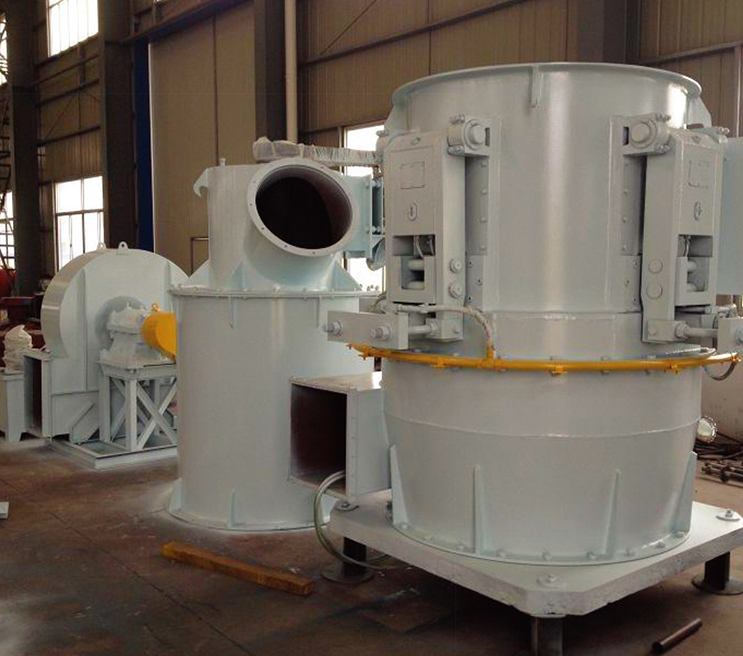
Ball mills dominate legacy barite operations. They deliver volume. But their over-grinding rate of 30-40% under 6 microns constantly threatens API 13A compliance. The LYH998 4-roller Raymond grinding pendulum mill addresses this directly: material exits the grinding zone through a classifier the moment it reaches target fineness, cutting over-grinding by nearly half compared to open-circuit ball milling.
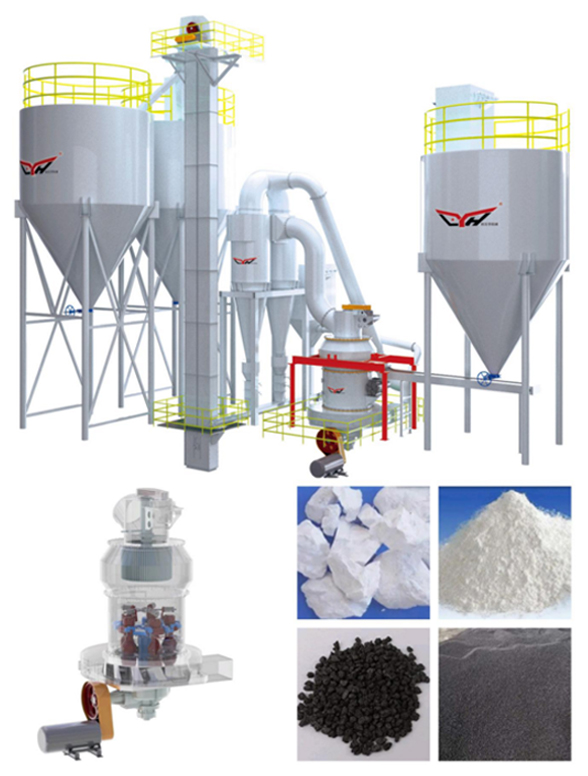
For operations targeting D97 below 20 microns — common in high-solid industrial coatings — the LYH996 series intelligent vertical ring roller mill combines multi-pass grinding with a high-precision rotor classifier. It produces a steep PSD curve with D50 around 8-12 microns while holding sub-6-micron content below 15%. Jet mills achieve even finer distributions but at energy costs five to ten times higher. They earn their place only when D50 below 3 microns is non-negotiable.
Key Process Parameters for PSD Control
Three variables dominate PSD outcomes. Adjust them in isolation and you chase your tail. Adjust them as a system and you dial in distribution with precision.
Classifier rotor speed (rpm)
This is the primary PSD gatekeeper. Higher rotor speed generates greater centrifugal force, rejecting coarser particles back to the grinding zone. For API 13A barite, typical rotor speeds range from 800 to 1,200 rpm on a 400 mm diameter classifier. Increasing speed by 100 rpm can shift D50 downward by 2-3 microns. But push too far and fines recirculate endlessly, spiking energy use without yielding more product.
Grinding pressure (MPa)
In roller-based mills, grinding pressure determines the fracture intensity per pass. For barite, pressures between 8 and 12 MPa produce consistent D50 in the 15-25 micron range. Below 8 MPa, throughput suffers and coarse tails expand. Above 14 MPa, the mill generates excessive fines in a single pass, overwhelming even a fast classifier. The sweet spot keeps the reduction ratio per pass manageable.
Airflow volume (m³/h)
Airflow transports classified fines out of the mill. Insufficient flow starves the classifier, letting coarse particles accumulate. Excessive flow drags oversized material through before the rotor can reject it. For a mid-size Raymond mill processing barite, 18,000-22,000 m³/h typically balances transport efficiency with classification precision. Operators should monitor differential pressure across the classifier as a real-time indicator of flow adequacy.
The interaction logic is straightforward: classifier speed sets the cut point, grinding pressure supplies the feed distribution, and airflow governs the throughput ceiling. Change one and the other two require rebalancing. A 15% increase in classifier speed without a corresponding airflow adjustment often drops throughput by 10-12% as material recirculates rather than exits.
How to Prevent Over-grinding: A Step-by-Step Guide
Over-grinding is preventable with disciplined process design and maintenance. The following steps form a practical sequence that any barite processing plant can implement.
- Control feed size below 20 mm. Feed particles larger than 25 mm force the mill to use high impact energy that shatters material indiscriminately. A jaw crusher or hammer crusher upstream should deliver uniform 10-20 mm feed. Consistent feed size stabilizes the mill's internal load and makes classifier settings repeatable.
- Set the grinding-pressure-to-classifier-speed ratio correctly. For barite, aim for a ratio where classifier speed (rpm) divided by grinding pressure (MPa) falls between 80 and 110. This keeps the mill producing primarily in the target size range, not over-fracturing already-fine material.
- Operate in closed circuit only. Open-circuit grinding has no mechanism to remove fines before over-grinding occurs. A closed circuit with a dynamic classifier ensures that material reaching specification exits immediately. This alone can reduce sub-6-micron content by 10-15 percentage points.
- Match classifier type to your D97 target. Turbine classifiers work well for D97 above 45 microns. For D97 below 20 microns, a rotor-type classifier with high blade density and tip speeds above 50 m/s provides the sharp cut that prevents fines carryover.
- Inspect and replace grinding elements at 15% wear. Worn grinding rollers or rings reduce contact pressure, forcing operators to compensate with higher force settings that generate erratic PSD. A roller worn beyond 15% of its original profile can shift D50 by 4-5 microns and increase fines by 8-10%. Scheduled replacement is cheaper than off-spec product.
- Monitor differential pressure across the classifier continuously. A rising pressure drop signals increasing recirculation load and incipient over-grinding. Set alarms at 15% above baseline and investigate immediately. The fix is usually an airflow adjustment or a feed-rate reduction, not a classifier speed change.
Case Study: Upgrading from Ball Mill to Raymond Mill for Better PSD
A barite processing facility in Southeast Asia operated a 2.4 m x 7 m ball mill in closed circuit with a static classifier for API 13A-grade production. Product D50 averaged 18 microns, but the sub-6-micron fraction consistently ran at 35%, breaching the API 13A limit of 30%. Every third shipment required blending with coarser material, adding $18 per ton in handling costs.
The plant replaced the ball mill with a 5R Raymond mill equipped with a dynamic rotor classifier. Feed preparation and post-grinding handling remained unchanged. Within two weeks of commissioning, the results were clear.
| Metric | Ball Mill (Before) | Raymond Mill + Rotor Classifier (After) |
|---|---|---|
| Average D50 (μm) | 18 | 12 |
| Sub-6 μm fraction (%) | 35% | 18% |
| Specific energy (kWh/ton) | 52 | 40.6 |
| Annual output (tons) | 45,000 | 52,000 |
| API 13A compliance rate | 67% of batches | 96% of batches |
Energy consumption dropped 22%. Throughput rose 15% because the mill no longer wasted energy re-grinding fines. Most critically, API 13A batch compliance jumped from 67% to 96%, eliminating blending costs and shipment rejections. The capital recovery period on the upgrade was 14 months, driven primarily by energy savings and reduced off-spec losses. This outcome reflects the underlying principle: PSD control is not a laboratory abstraction. It shows up directly on the P&L statement.

 Email:
  Telephone: +86-13951382065
 Phone: +86-13951382065